You can purchase the book online or the old-fashioned way:
Click here to order via Paypal
Send us a check for $49.00 ($40 plus $9 shipping and handling in the U.S.)
(Please contact rebecca@rebeccabarry.net for mailing address or for a quote on international shipping.)

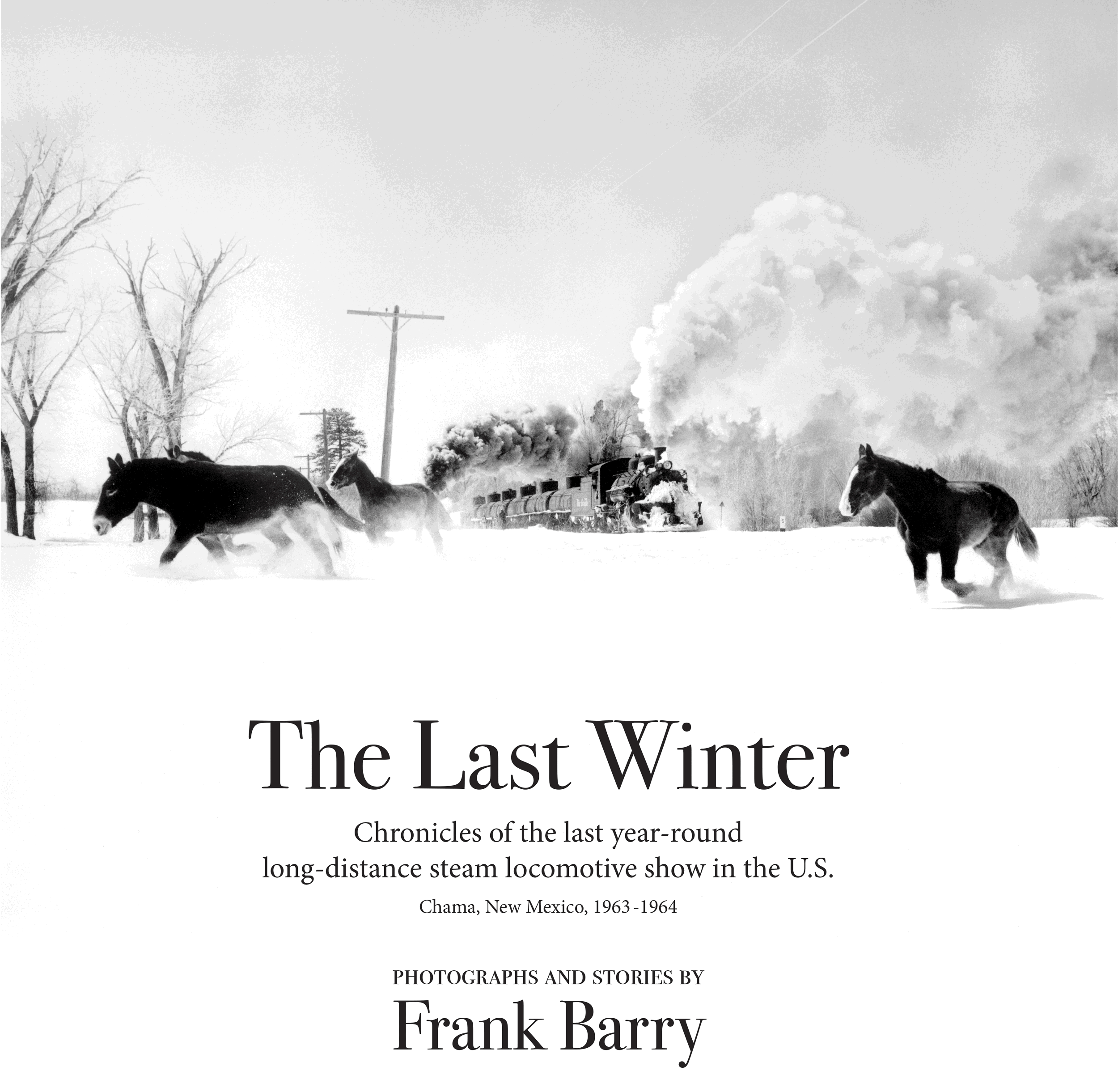
About The Last Winter: The first of Frank’s books features stunning black-and-white photos taken in and around Chama, New Mexico, mostly during the winter of 1963-64. It was the last full winter that steam engines ran long-distance in the U.S.
The book was started as a family project after Frank gave a talk about Chama for the Cornell chapter of the National Railway Historical Society in Ithaca, New York. Frank’s daughter Rebecca recorded him talking about taking the photos — where he was standing (usually in a tree or on an outcropping of rock at the top of a cliff), how cold it was, what he had to do to get the right frame. During Covid, she and Frank worked together on the text — putting together the pictures and their stories — along with Barbara, Frank’s wife, who wrote the preface. The book was designed by Rebecca’s husband Tommy, and produced with the help of Della Mancuso, Robyn Wishna, and Joe Lamarre. The result is a rare and soulful collection that captures a time and way of life that no longer exists. Not many photographers made it out to Chama that winter, and fewer still wanted to wade knee-deep through snow to take pictures of the engines. We are happy to be able to share it with you!


About the Author: Frank Barry has been chasing trains since he was 4 years old. In the late 1950s and early 1960s he hitchhiked throughout the U.S., Canada, Mexico, Central America, and Europe with his Rolleicord, taking pictures of steam locomotives and the people who ran them. His photos and articles have appeared in magazines including Trains, Classic Trains, The Washington Post Magazine, Railroad Heritage, and Railroad History. His work has also been featured in 23 books, including Trains magazine’s 100 Greatest Railroad Photos, and has been exhibited at Cornell University’s Herbert F. Johnson Museum of Art.
The Last Winter
This striking collection of photos by rail photographer Frank Barry features pictures taken on a section of the Denver & Rio Grande Western between Chama, New Mexico, and Antonito, Colorado, in the winter of 1963-64. It was the last time that steam engines hauled long-distance cargo trains year-round in the United States, though steam now runs on that route with the Cumbres & Toltec Scenic Railroad.
The book includes stories by the photographer about where and how each picture was taken. It was edited, designed, and produced by Frank’s daughter Rebecca and his son-in-law Tommy Dunne, with a foreword written by his wife, Barbara.
Below, read the review of The Last Winter by Kevin P. Keefe which appeared in Classic Trains magazine and is reprinted here with the author’s permission.
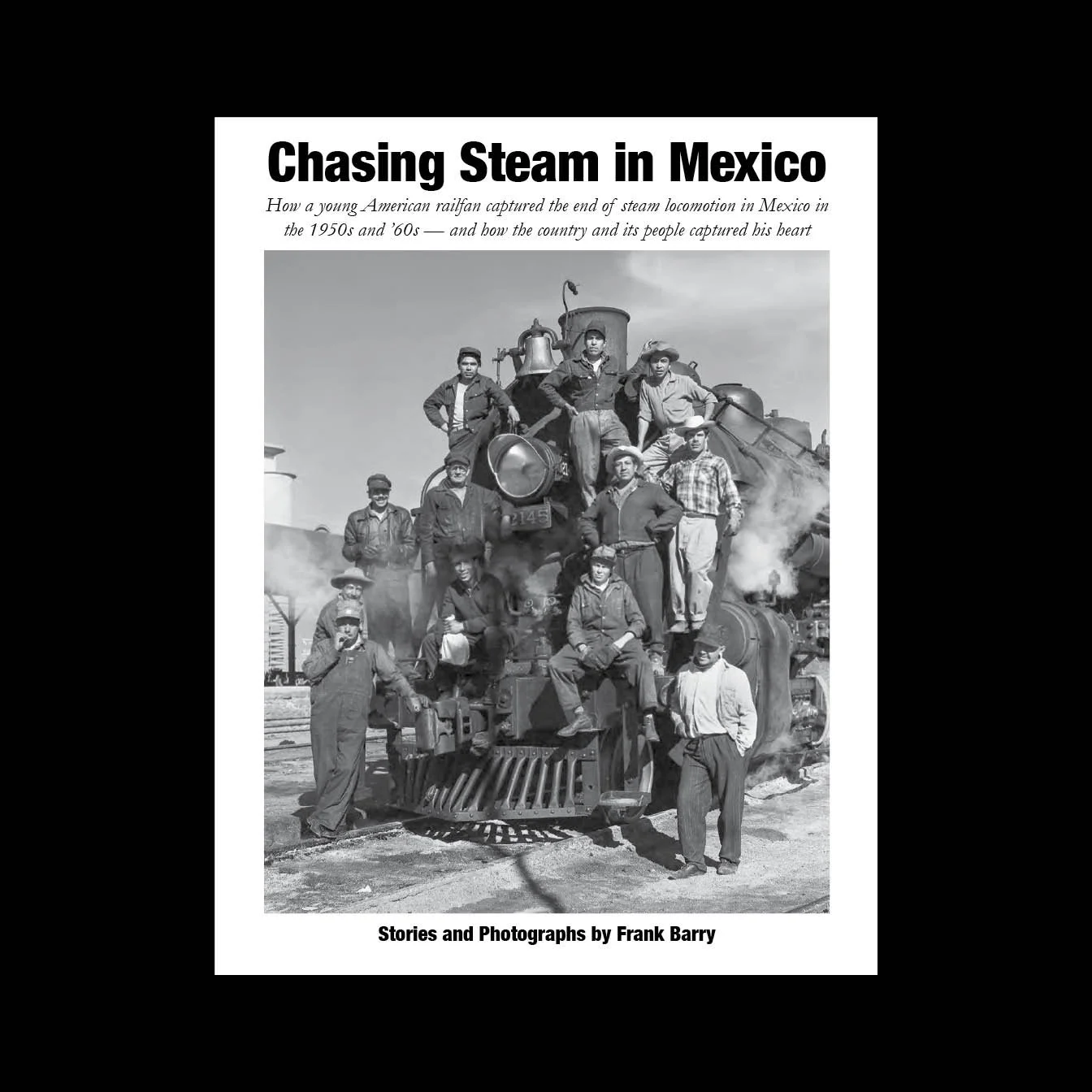
Chasing Steam in Mexico takes readers on a journey through Mexico's railroads in the late 1950s and early 1960s. Through over 300 black-and-white photographs and firsthand stories, Frank Barry captures the steam locomotives, people, and everyday life of a time long past.
368-page hardbound book. Price includes shipping.
“Frank Barry honors the Colorado narrow gauge” —Classic Trains magazine
In the 1950s and early 1960s, the Denver & Rio Grande Western’s narrow-gauge lines in southwest Colorado and a bit of northern New Mexico drew photographers like hummingbirds to columbines.
And why not? What could be more magical than this Brigadoon-like world of three-foot-gauge track, wooden cars, and 2-8-2’s, surrounded by the majesty of the San Juan Mountains?
An A-list of shooters descended over the years on Antonito, Chama, Durango, Silverton, and other memorable places on the “silver San Juan.” You’d recognize the names: Dick Kindick, Otto Perry, Philip R. Hastings, John Gruber, Jim Shaughnessy, Dick Steinheimer, and so many more.
That list would not be complete without including Frank Barry, an insightful photographer whose penetrating black-and-white images just might convey better than anyone else’s the last months of regular steam freight service on D&RGW. The evidence is in a lovely book called “The Last Winter,” just out on Barry’s own Fresh Dirt Publications imprint.
It’s a big book in format — the 12 x 12 size allows for generous images — and the printing and paper quality more than make up for the relatively compact 66 pages. The hardcover book is priced at $40 and is available at the photographer’s website, www.frankbarryphotography.com.
The book chronicles Barry’s various visits to D&RGW steam territory but, as the title implies, specifically concentrates on the winter of 1963-’64 at Chama, where Barry and his wife, Barbara, holed up for several months. From there they covered virtually all of the narrow gauge between Antonito on the east and Durango in the west.
Barry’s book has won the endorsement of Scott Lothes, executive director of the Center for Railroad Photography & Art (www.railphoto-art.org), which in the past has showcased the photographer at its annual conference.
“As a steam photographer, Frank inserted himself deeply into the places, operations, and communities he was covering,” Lothes says. “By living and working in Chama, he got to know the Rio Grande narrow gauge lines far better than the typical photographer who just visited the area for a few days. Frank’s ‘residential’ approach gives his work an intimacy that still resounds nearly six decades later.”
Barry’s motivation was simple: he wanted to catch what he calls “the last long-distance steam locomotive show in the United States.”
Frank and Barbara were outlanders, as it were, Easterners who had decamped from Pennsylvania to experience winter in the mountains. They were a young couple with a sense of adventure, something that shows up in the book’s engaging text, which includes a lovely essay by Barbara. This was a railfan spouse who earned her stripes! Just listen to her description of getting dragged over to the Chama enginehouse in the dead of winter:
It was cold, so I didn’t want to go, but he was excited, I thought, it’s an adventure, and put on my coat and boots. We went to the railroad yard and there was this big snow-bedecked engine softly steaming as it settled down from its run. It was magical. I held the shutter open as Frank ran around and fired off flash bulbs and I thought to myself, Now I can see what he sees!”
Frank Barry saw a lot, especially when it came to creating sweeping portraits of a majestic landscape challenged by small but powerful steam locomotives. Nearly all the fabled locations on the D&RGW are here: a 2-8-2 lugs cattle cars up to Windy Point; a lead engine and helper eases a train over Lobato Trestle; an eastbound freight is silhouetted against a blindingly brilliant snowscape at Los Pinos; a 2-8-2 and helper send a cannonade of exhaust smoke skyward as they hug the mountainside between Cresco and Coxo.
In perhaps my favorite photo in the book — I should say my favorite three photos —a train snakes its way through Toltec Gorge from a perspective showing what must be 40 miles of scenery in the distance. The huge image is actually a blending of three separate photographs into a composite print. Here, Barry truly captures the majesty of the San Juans and has made the good decision to carry it across the full 24 x 12 inches of a spread.
Barry’s photos have intimate moments, too: the bone-chilling cold of a winter night at the Chama shops as snow begins to blanket resting 2-8-2s awaiting the next morning’s assignments; the loading of cattle into stock cars, a ritual that would last but a few more months; and a view of the photographer himself, tending to that common curse of a railroad photographer in the field — a flat tire.
Barry is an engaging writer with a fine eye for detail, and he obviously took good notes. In summing up his experiences in and around Chama, he writes: “When I took these photos, the end was near, but I did not know I was in fact recording the very last winter of regular steam operation in severe weather conditions anywhere in North America. I was very lucky to be there.”
Thanks to Frank Barry’s often spectacular, sometimes heartbreaking book, we are, too.